






Sensation & Perception: Experiment 3
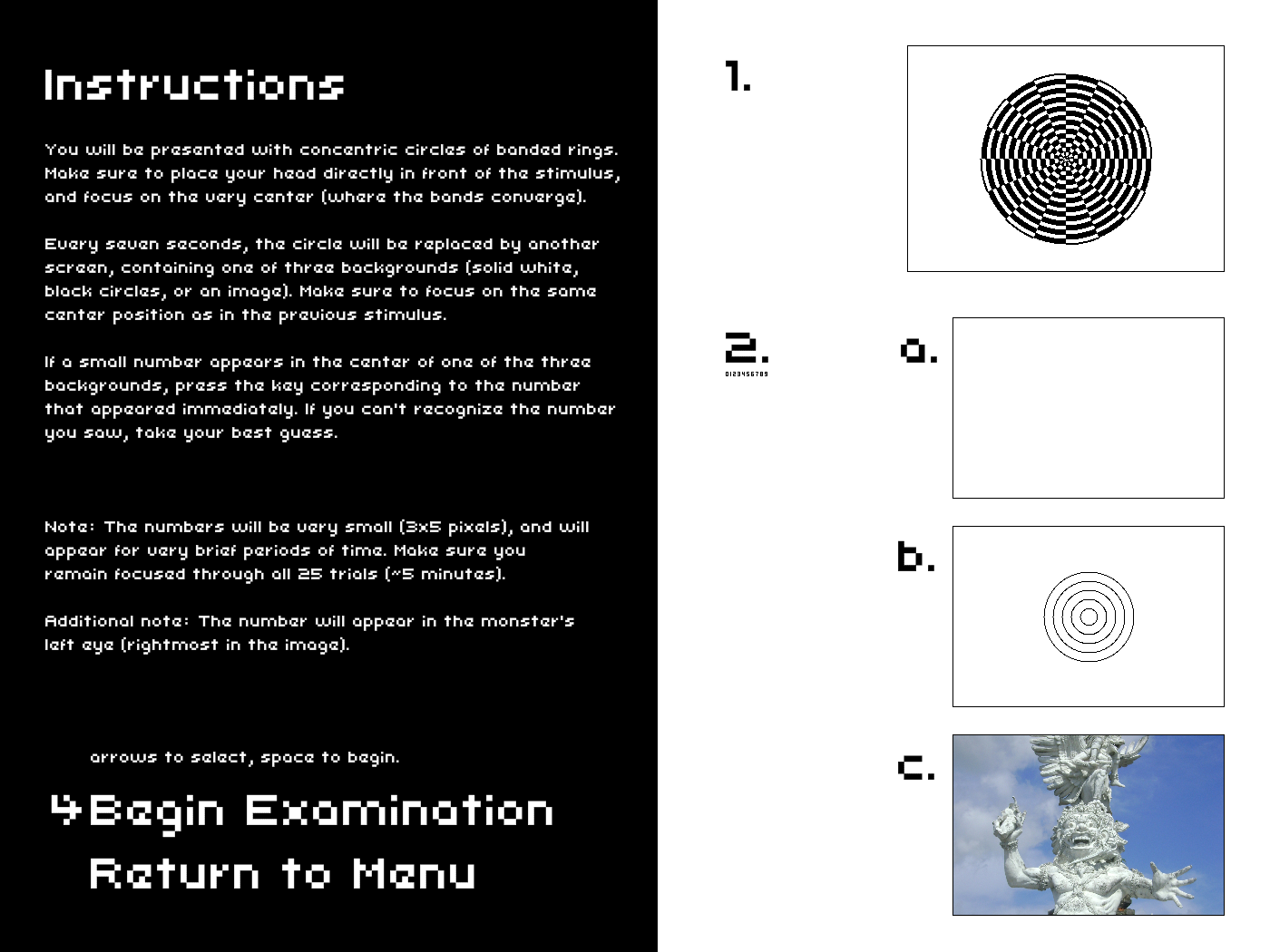

click for larger versions.
Synopsis:
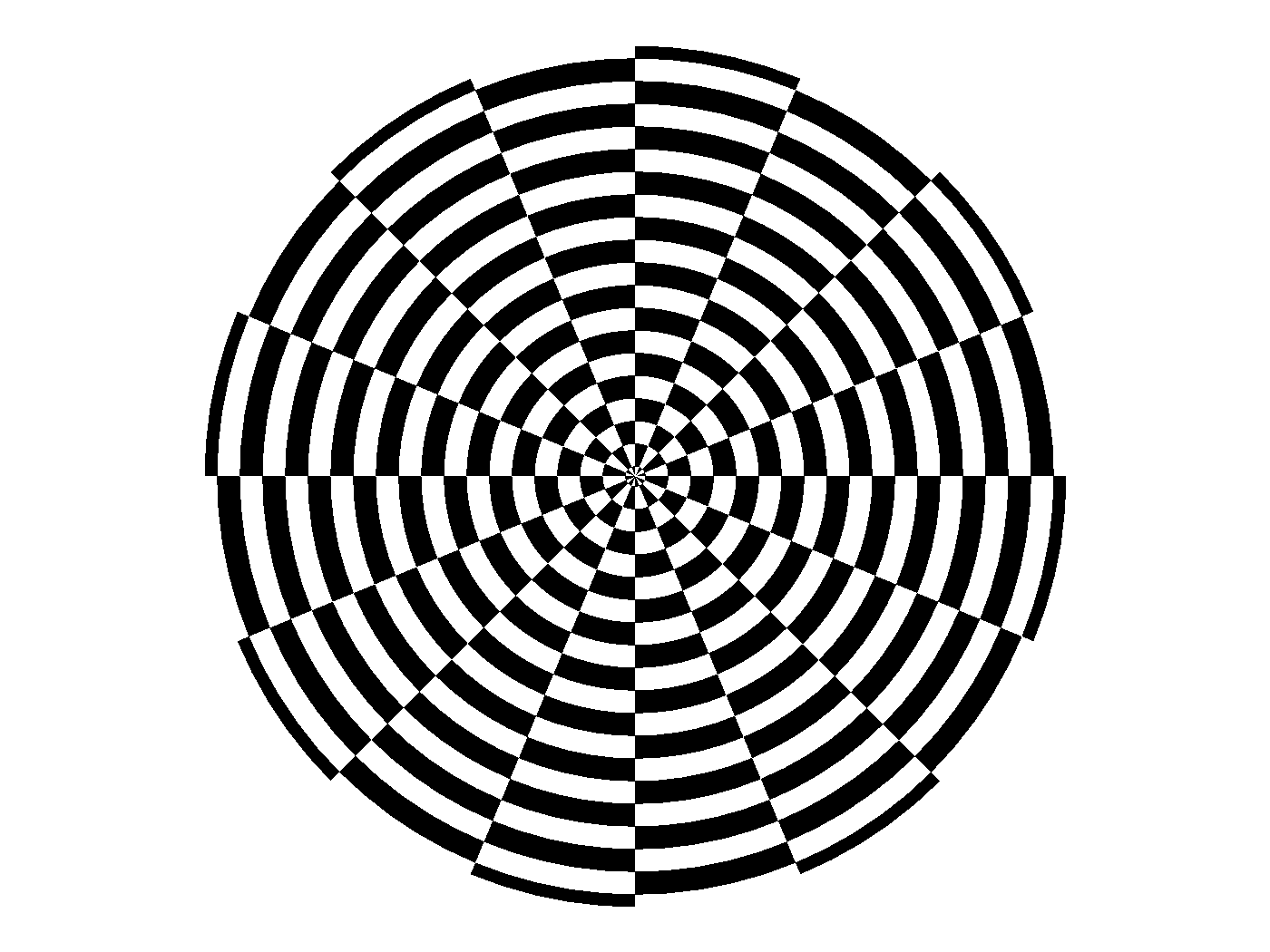
A project for a psychology class at RPI - Sensation & Perception. This assignment concerned the waterfall illusion, which occurs when looking at consistent motion for a period of time. Originally inspired by the fact that looking at a waterfall, then the rock wall next to it makes the rocks appear to be moving upwards, the effect also applies to circular motion.
The experiment presented a high-contrast circle of alternately banded rings, which moved towards the center at a constant speed. Then it presented one of three background stimuli (which represented high context, low context, and zero context), and flashed a very small number (3x5 pixels) for a brief period. Subjects were instructed to press the number key that corresponded to the number seen.
Because the motion of the banded rings moved inward at a constant speed, the backgrounds would appear to warp outwards from the same center point, and I believed that this would make the smaller numbers appear larger and more recognizable. The conclusions supported my hypothesis, as all three cases showed improved perception on the waterfall trials, vs. the control trials without the waterfall effect.
Graphs were composed that measured success by number, and also success by the time the number was displayed. The graphs of the control trials had a limit at around 90% success on even the longest display times (probably caused by the similarities between 2+3+5 and 6+8+9+0), while the graphs of the waterfall trials reached 100% success on both the low context and high context backgrounds. Also, improved perception was noted on nearly all the different success by number rates.
Requirements:
XNA Framework 3.0 or 3.1 (Windows only)
Either Visual C# 2008 Express (free) or Visual Studio 2008 (not...)
Note: Installing VC#2008 Express will not break a Visual Studio 2005 install.
Download Now
