






Sensation & Perception: Experiment 2
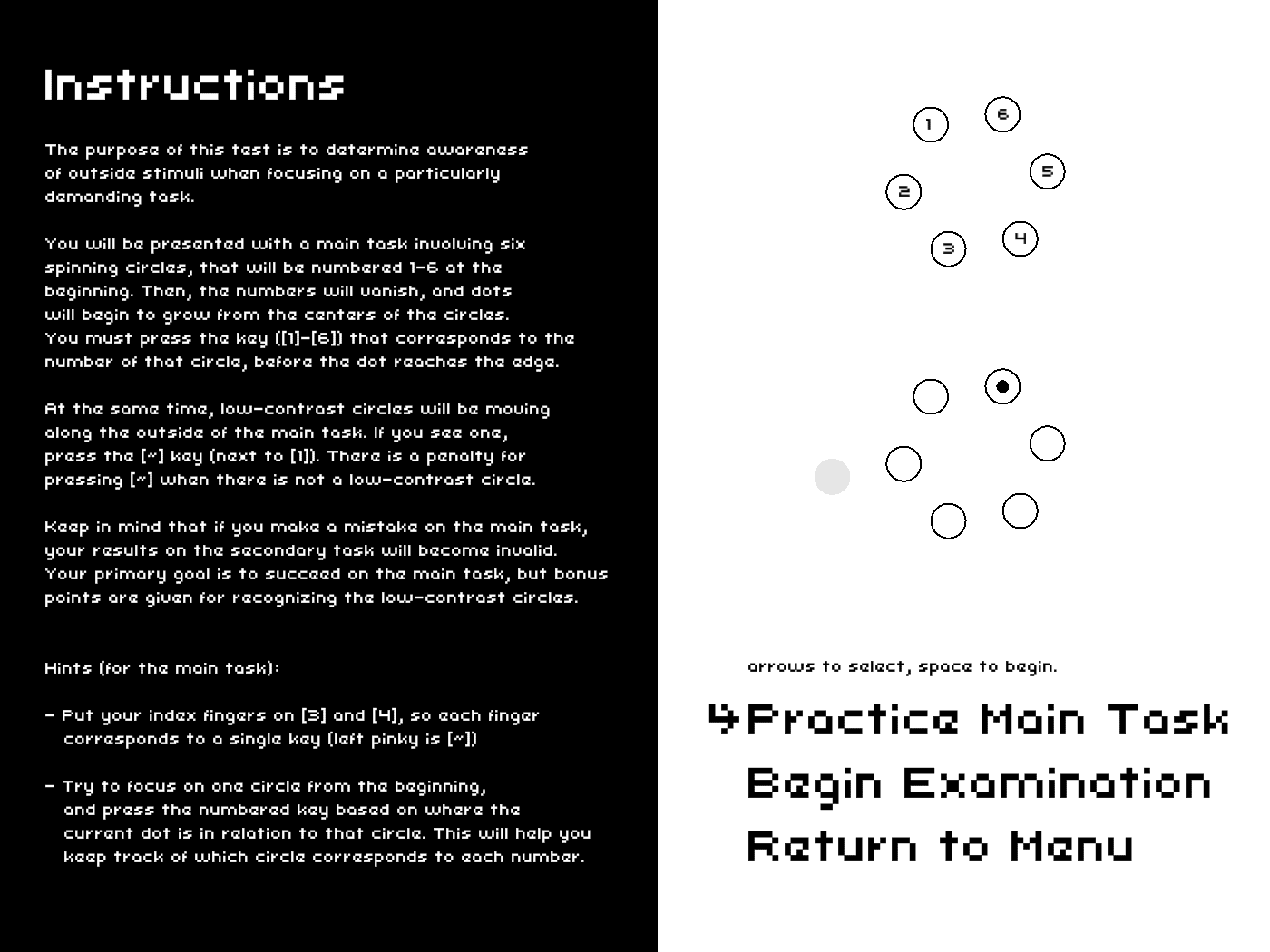

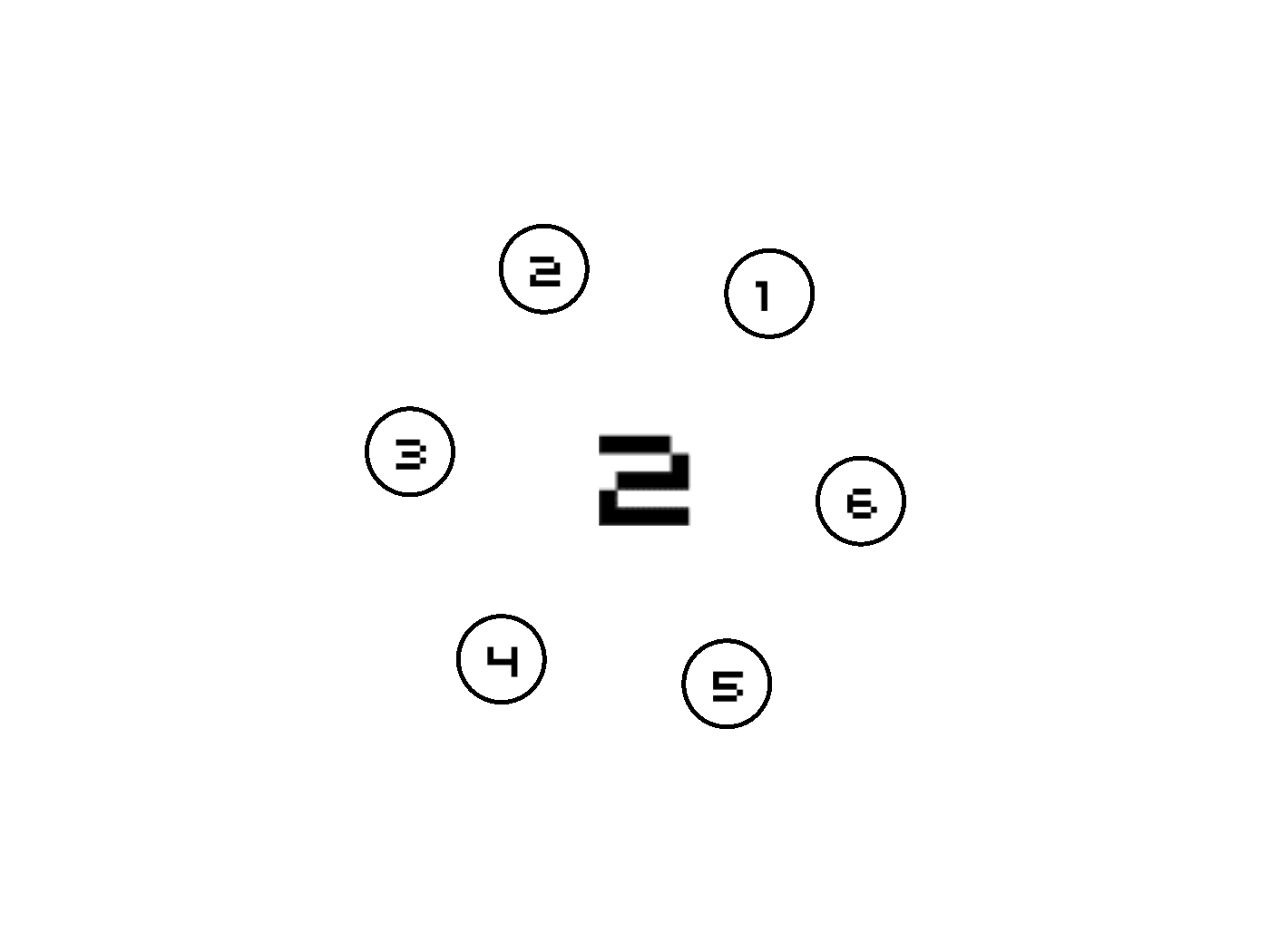
click for larger versions.
Synopsis:
A project for a psychology class at RPI - Sensation & Perception. This assignment concerned inattentional blindness, and the fact that intense focus creates a sort of tunnel vision. Unfortunately, testing inattentional blindness is difficult, as it is generally done by not presenting the external stimuli to the subject, effectively only allowing one trial before "the secret" is out.
I wanted to make an experiment that could provide a larger sample from subjects, by presenting the external stimuli at the start, and only considering the results valid if the subject was performing well on the main stimulus. The main task was designed to be very demanding, and required a great deal of concentration. This was intended, so that inattentional blindness would still be present despite the subject's awareness of the external stimuli.
The main stimulus was a set of six circles, that span counter-clockwise around the center of the screen. Once the experiment began, the numbers faded out, and a dot would grow from the center of one of the empty circles. Subjects were required to press the key ([1] through [6]) that corresponded to that circle, before the dot filled the entire circle. Because the whole scene was constantly spinning at a variable speed, it required intense focus to keep track of which circle corresponded to which number.
The external stimuli were low-contrast circles that moved around the outside of the main stimulus, fading in and out smoothly to avoid the instant awareness that high-contrast changes produce. These circles would randomly move with or against the main stimulus, at variable distances from the current growing dot. The goal was to determine whether certain speeds, directions, or proximity to the main stimulus allowed better recognition of these stimuli, and further analyze the inattentional blindness phenomenon.
Ultimately, the results were inconclusive. My sample (the class) had very few students that played video games on a regular basis, and they found the main task to be too difficult. In 2800 main task trials, the average success rate was ~17% (which was calibrated to my 95-100% success rate), and this only allowed about 120 valid external stimuli trials. Unfortunately, it was difficult to balance the main task against the individual subjects, because it needed to be completely attention consuming for the external trials to be valid.
Requirements:
XNA Framework 3.0 or 3.1 (Windows only)
Either Visual C# 2008 Express (free) or Visual Studio 2008 (not...)
Note: Installing VC#2008 Express will not break a Visual Studio 2005 install.
Download Now
